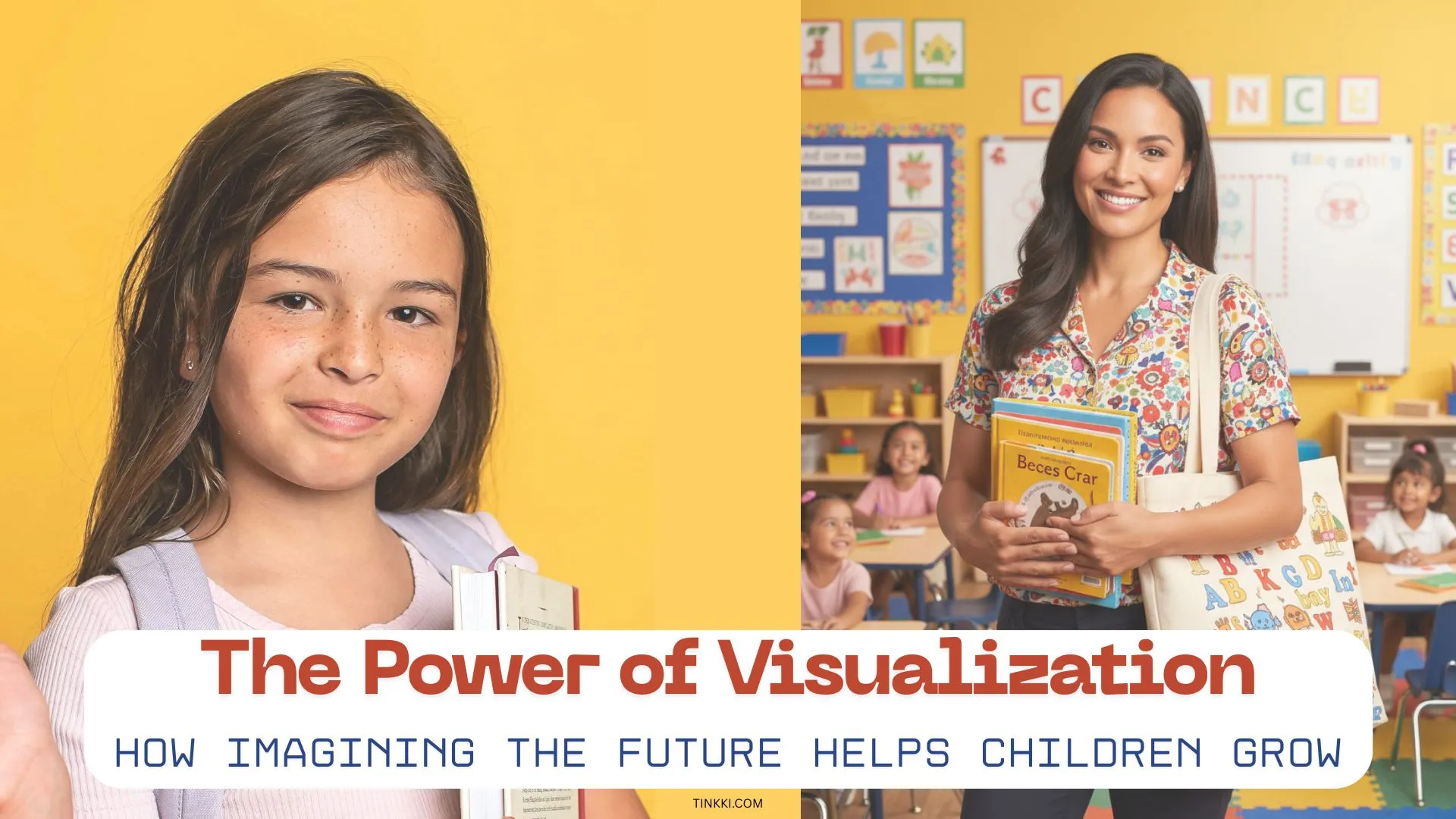
Every child has a dream. Some want to fly planes, others want to save animals, paint masterpieces, or build rockets. When children talk about what they want to be when they grow up, it might sound like simple play, but it is much more than that. Dreaming about the future is how children begin to understand who they are and who they might become.
Me, founder of Tinkki and author of this article, I believe imagination is not just playtime. It is the foundation for motivation, confidence, and learning. When children (like my niece, where I got the whole idea about this platform) can actually see themselves in their dream job roles, they start to believe that their dreams are possible. That belief is powerful, and scienece agrees (you'll see some citations below).
I've made this article to see what research says about visualization in childhood, how imagination shapes self-confidence, and why giving children visual tools like Tinkki helps them grow stronger, happier, and more motivated to reach their goals.
1. The Science Behind Imagination and Visualization
The idea that imagining yourself in the future can influence your real-life actions has been studied for decades. One of the most important studies comes from psychologists Hazel Markus and Paula Nurius, in their paper Possible Selves published in American Psychologist in 1986.
They introduced the concept of “possible selves”, describing how people imagine who they might become, who they would like to become, and who they are afraid to become.
According to their research, imagining these future versions of ourselves helps us make decisions and take actions that bring us closer to those imagined futures (Markus & Nurius, 1986).
Possible Selves by Markus & Nurius (1986, American Psychologist)
If someone from American Psychologist reads this, please contact me since I need to beg my friends to get access to your papers.
In simpler words, when a child pictures themselves as a doctor or an artist, that image helps shape the path they take. They begin to think, learn, and behave in ways that fit that dream.
More recent research supports this idea. In 2020, Olesya Blazhenkova and colleagues published a study in Heliyon, available on ScienceDirect, showing that visualization and pretend play help children develop memory, emotional understanding, and creativity. The study demonstrated that imagining future scenarios is not just entertainment; it helps children build mental images that strengthen learning and problem-solving. Eg. I've bought entire Dentist set for my niece since she once mentioned to me she want's to become a Dentist, and trust me, that costume and Dentist set was her favorite thing to play with for months. She even fixed teeth for the entire family :D
Another important study, Development of Self-Concept in Childhood and Adolescence (2024), published in Human Development, explains how children who have a positive and clear sense of who they are tend to do better later in life.
Development of Self-Concept in Childhood and Adolescence (2024, Karger)
The researchers found that self-concept, the way children see themselves, begins forming early. When children believe they can do something, they become more motivated, persistent, and resilient. Visualization helps them imagine those successful versions of themselves and strengthens their confidence.
A related study by Neil Harrison (2018), published in Social Sciences, used the same theory of “possible selves” to explore how young people imagine their education and future careers.
Using the Lens of ‘Possible Selves’ to Explore Access to Higher Education (2018, MDPI)
Harrison found that young people who visualize themselves succeeding are more likely to stay motivated in school and pursue long-term goals. The idea of a “future self” helps them stay focused and resilient even when life gets challenging.
2. Research Spotlight – The “Possible Selves” Theory
In their landmark study Possible Selves (1986), Markus and Nurius explained that everyone carries mental images of who they might become, who they hope to become, and who they fear becoming. These inner pictures, called possible selves, are not random fantasies. They are the “cognitive components of hopes, fears, goals, and threats,” giving shape and direction to a person’s behavior (Markus & Nurius, 1986).
They discovered that these imagined future selves act as a bridge between thinking and doing, between imagination and motivation. When people visualize a version of themselves in the future, their mind begins preparing for that version. This is why visualizing success, even through a simple image, can improve confidence and focus.
Markus and Nurius also found that possible selves are influenced by the culture, heroes, and social models we see around us. As they wrote, “What others are now, I could become.”
When children see positive role models such as parents, teachers, or even themselves in inspiring roles, it becomes easier for them to believe those futures are achievable.
This directly connects to how Tinkki works. When a child sees themselves as a doctor, firefighter, or astronaut, it activates the same motivational process described by Markus and Nurius nearly forty years ago. Visualization becomes more than fun; it becomes the start of self-belief.

ABSTRACT from 'Possible Selves' by Hazel Markus and Paula Nurius PDF document
"The concept of possible selves is introduced to complement current conceptions of self-knowledge. Possible selves represent individuals' ideas of what they might become, what they would like to become, and what they are afraid of becoming, and thus provide a conceptual link between cognition and motivation. Possible selves are the cognitive components of hopes, fears, goals, and threats, and they give the specific self-relevant form, meaning, organization, and direction to these dynamics. Possible selves are important, first, because they function as incentives for future behavior (i.e., they are selves to be approached or avoided) and second, because they provide an evaluative and interpretive context for the current view of self. A discussion of the nature and function of possible selves is followed by an exploration of their role in addressing several persistent problems, including the stability and malleability of the self, the unity of the self, self-distortion, and the relationship between the self-concept and behavior."
3. Why Visualization Matters in Childhood
Visualization is a skill that connects imagination to action. When children see a picture of what they might become, it becomes easier for them to understand what it takes to get there. It is the first step in turning an idea into a plan.
Let’s look at what visualization actually does for children:
a) It builds self-confidence
When children see themselves in a strong and capable role, they start to believe that they have what it takes. This belief in their ability to achieve is called self-efficacy, and psychologists have shown it is one of the biggest predictors of success later in life.
b) It improves motivation
Visualization creates an emotional connection to the goal. A child who sees themselves as a veterinarian or teacher is not just thinking about the title; they imagine the feeling of helping others or creating something important. That emotional connection keeps them motivated over time.
c) It strengthens learning and creativity
Research has shown that when children visualize concepts, their memory and understanding improve. Visualization combines imagination and focus, allowing children to explore abstract ideas in a concrete way.
d) It supports emotional development
Children who imagine themselves in different roles learn empathy and perspective. They understand what others might feel or experience, which improves emotional intelligence.
e) It helps with decision-making
When children imagine their future selves, they start thinking about what steps they need to take. They may ask questions like, “What do I need to learn to become a doctor?” or “How do I help animals?” This curiosity leads to learning and goal-setting naturally.
Markus and Nurius also observed that possible selves serve as “incentives for future behavior.” People naturally move toward the selves they want and away from the ones they fear. Children who can visualize a positive version of themselves develop optimism and confidence. When they cannot imagine a hopeful future self, they may feel uncertain or unmotivated. Visualization helps direct their energy toward the positive picture, turning hope into action (Markus & Nurius, 1986).

4. How Tinkki Turns Research Into Real Smiles
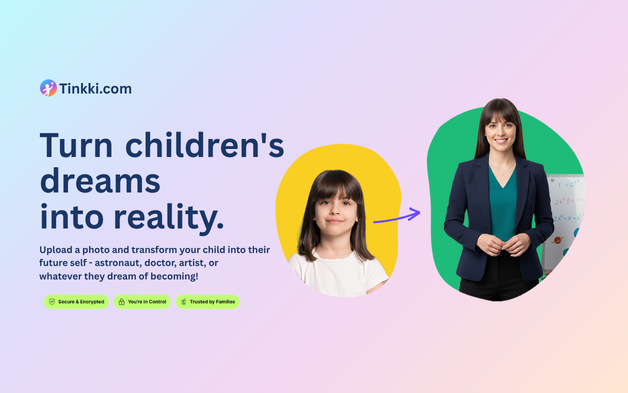
All of these findings inspired how Tinkki was built. Tinkki is not just a dream job photo generator. It is a digital tool that takes real science about imagination and motivation and turns it into a fun, emotional experience for families (powered by nieces' smiles).
Here’s how it works in practice:
-
Children imagine what they want to be – This could be something traditional like a doctor, pilot, vet or something new like a game designer, YouTuber, influencer.
-
Parents or teachers upload a photo – The system safely and privately creates an image of the child as their future self.
-
The result becomes a mirror of possibility – When the child sees themselves in that role, it creates joy, curiosity, and belief.
Behind each image lies science and care. Markus and Nurius showed that people’s possible selves are shaped by social experiences and role models. Tinkki gives children the chance to become their own role model, to visualize themselves achieving something meaningful and to start believing in it early.

5. What This Means for Parents and Educators
Parents and teachers play a key role in shaping how children think about their future. By using visualization intentionally, adults can help children discover their strengths, passions, and values.
Here are a few ways to use Tinkki and the idea of visualization at home or in class:
-
Ask questions that spark curiosity. After creating a Tinkki photo, talk about what the child enjoys about that role. Ask what they think this job does and what skills it requires.
-
Connect dreams to actions. If a child says, “I want to be a scientist,” you can help them explore science videos, museums, or books.
-
Celebrate effort, not only dreams. Remind children that every big dream starts small, and learning, patience, and curiosity are part of the journey.
-
Show diversity of possibilities. Let children explore many roles, not only traditional ones. Tinkki can show them that every dream is valid, whether creative, technical, or humanitarian.
Visualization also helps in emotional moments. If a child feels unsure about themselves, reminding them of their “future self” can bring comfort and hope.

6. The Bigger Picture: A Future Built on Belief
When we talk about education, we often focus on reading, math, and test scores. But emotional and imaginative skills are just as important. A child who can imagine their future and believe in it is already one step closer to making it real.
That’s what Tinkki is really about. It is not just a platform that creates pictures. It is a bridge between imagination and reality. Every photo is a conversation starter, a spark of motivation, and a reminder that dreams matter.
In a world where technology often distracts children, Tinkki uses technology to inspire. It encourages positive digital experiences, strengthens family bonds, and reminds children that their dreams are worth believing in.
7. Final Thoughts
Visualization is not just for adults or athletes preparing for success. It is a natural, powerful tool that every child already uses. The difference is whether we, as parents and educators, choose to nurture it.
Research tells us that imagination and self-concept begin forming early. The more we support that process, the more confident and motivated our children become.
So, the next time your child says, “When I grow up, I want to be…”, take it seriously. Help them picture it. Show them that their dreams are real, visible, and worth pursuing.
That’s the mission of Tinkki: to make every child believe in their dreams through the power of visualization.
P.S. And yes, if their dream jobs might sound crazy, don't ever tell them they should be something else. If they want to be a waitress, support them; if they want to be a plumber, support them. And support them in a way that they become the best waitress of all. Don't hold them back for the simple reason that you want them to earn a lot, and because you think they can only do that if they become lawyers or doctors. Some waitresses earn over $100,000 per year. Remember that. "Here's what it takes to make $100,000 a year as a waiter in NYC"
👉 Start your child’s first dream photo today.
📚 References
-
Markus, H. & Nurius, P. (1986). Possible Selves. American Psychologist, 41(9), 954–969. Read PDF
-
Blazhenkova, O., Kozhevnikov, M., & Motes, M. (2020). Individual Differences in Visualization and Childhood Play. Heliyon, 6(6), e04297. Read on ScienceDirect
-
Development of Self-Concept in Childhood and Adolescence. (2024). Human Development, 68(5–6), 255–272. Read on Karger
-
Harrison, N. (2018). Using the Lens of ‘Possible Selves’ to Explore Access to Higher Education. Social Sciences, 7(10), 209. Read on MDPI